Cat-Proofing a Florida Backyard Fence: Toppers, Gaps, Launch Points, and When a Catio Is Better
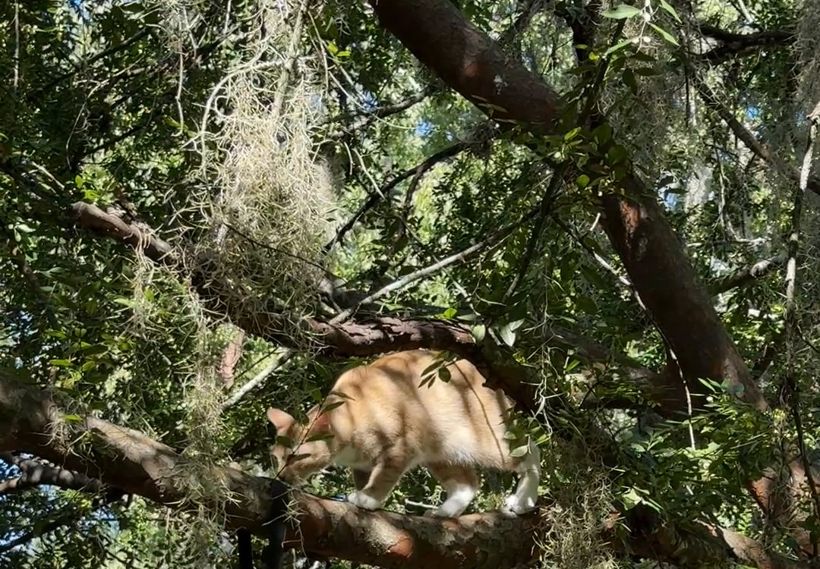
Felix and Cleo go out on their own twice a day, inside a vinyl privacy fence that runs around our whole backyard. By our estimate it's 6 to 7 feet tall. Neither cat has ever gone over it, but "hasn't yet" isn't the same as "can't." So we went through what the cat-welfare and Florida wildlife sources say about cat-proofing a fence: how cats get out, what fence toppers do, the gaps and launch points people miss, and what changes in Florida because of hurricanes, HOAs, sun, and coyotes. We also cover when a catio is simply the better answer.
Where we're starting from
- The fence: solid vinyl privacy panels around the whole backyard, roughly 6 to 7 feet high. There's no topper on it.
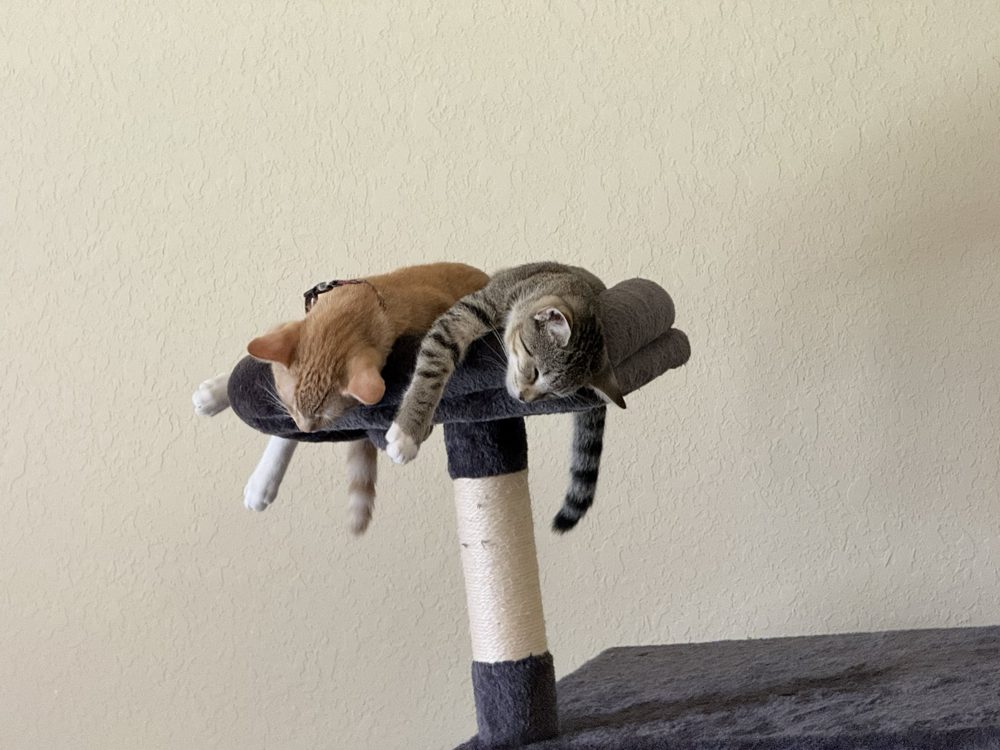
- The cats: Felix, our orange boy, runs in when he's called. Cleo, our gray tabby, wears a breakaway collar, hunts lizards, and comes in when she feels like it. Both are microchipped.
- The weak spot we already know about: a large tree about 5 feet from the fence that Felix loves to climb. We wrote about it in our morning and evening backyard time guide.
To be upfront about the official position: FWC advises against letting pets free-range and recommends keeping cats indoors to protect them from coyotes. [10][13] The ASPCA also asks owners to keep cats indoors. [14] We've chosen fenced outdoor time anyway, and this page is about making the fence do more of the work.
How cats get over, under, or through a fence
- Over the top. Cats Protection, the UK cat charity, puts it plainly: cats are great climbers and jump over most fences. [4] That's why the cat-proofing sources focus on the top of the fence rather than just its height.
- From a launch point. A tree, shrub, or anything else close to the fence gives a cat a step up. International Cat Care (iCatCare) warns that trees overhanging a fence may let cats climb out, and the Cat Protection Society of NSW says trees and shrubs near the fence should be trimmed to remove climbing and jumping sites. [1][5]
- Under or through. Humane World for Animals says cats are great climbers and "sometimes even wily diggers," so an enclosure shouldn't have openings a cat could squeeze through. [7] iCatCare's checklist before first outdoor time includes blocking holes in fencing. [2]
- The urge to roam. iCatCare says unneutered male cats roam over a large area looking for a mate and may not return, and it recommends neutering before any outdoor access. [17][2] A fence is working against much less if the cat is neutered.
- Ingenuity. The Cat Protection Society of NSW notes that some cats find ways around an enclosure that didn't occur to the designer. [5] Watching how your own cat tests the fence tells you more than any spec sheet.
Is a 6-foot fence enough on its own?
Usually not, according to the cat-proofing guidance. iCatCare says a garden needs a border fence of at least 1.8 m (about 6 feet) to be cat-proof, and then an overhang on top: a horizontal section jutting into the garden at least 0.5 m (about 18 inches to 2 feet), or one built at an upward 45° angle. [1] Cats Protection says a two-metre (about 6.5-foot), close-boarded fence with a hedge running parallel to it will encourage a cat to stay in the garden, and suggests extras on top as a further deterrent. [3][4]
Our reading for our own yard, not an official rule: a solid 6-to-7-foot privacy fence covers the height part of that guidance. What it doesn't have is the overhang, and that's the piece the sources treat as what makes a fence cat-proof.
Fence-topper options
The sources describe the same handful of approaches. RSPCA NSW lists netting, rolling cylinders, smooth metal or plastic sheeting, and inward-inclined wire as examples of escape-proof tops, fitted either to a new fence or retrofitted to an existing one. [6]
- Angled or overhanging toppers. Brackets that hold mesh or netting out over the yard, either flat at a right angle or tilted up at 45°. This is the design iCatCare describes, and it says overhangs can be made from wood or wire or bought from specialist companies. [1] Cats Protection mentions angled trellis as well. [4]
- Netting extensions. Flexible netting that extends the fence upward and inward. Best Friends Animal Society describes "cat fencing" as netting that attaches to standard fences to prevent escapes and intrusions. [9]
- Roller bars. A tube along the top of the fence that spins when a paw grabs it, so there's nothing to pull up on. RSPCA NSW lists rolling cylinders, and the Cat Protection Society of NSW describes fence-top rollers as an option that avoids netting. [6][5] FWC separately recommends "coyote rollers" as one way to stop coyotes from scaling privacy fences. [10] That's a different job (keeping coyotes out, not cats in), so we're not claiming a coyote roller is cat-proof. It's a design worth asking a manufacturer about if you want both.
- Smooth sheeting or taut wire. RSPCA NSW lists smooth metal or plastic sheeting, and Cats Protection mentions taut wire or string on top of a fence. [6][4]
Gaps under fences and at gates
Every source we read puts this step first. The Cat Protection Society of NSW says to start by sealing any gaps or holes in or under the existing fence before adding netting or other devices. If other pets or wildlife dig under the fence, you may need a ground-level guard as well. [5] FWC's coyote guidance also says to check the bottom of the fence regularly for holes. [10]
- Walk the fence line, low. Look along the bottom of every panel and post for washouts, dips, and spots where something has been digging. Heavy rain can wash soil out from under a fence line, so we'd check again after big storms. That's our reasoning, not a source's.
- Gates are the classic gap. Check the space under the gate and on the hinge and latch sides. iCatCare recommends a security catch that can be locked with a padlock on any gate giving people access to a cat enclosure. [1] Our suggestion: anyone who uses the gate, including lawn and pest-control crews, should know the cats may be out.
- Check where the fence meets the house. Gaps at corners and at the house wall are easy to miss from the yard.
- Ground guards. If something is digging under, the Cat Protection Society of NSW points to ground-level guards such as buried netting. [5]
Trees, sheds, and AC units: launch points
A topper only helps if the cat can't just jump over it from something taller. The sources cover trees in the most detail:
- Prune, or fence around the tree. iCatCare says pruning may help, or you may need to fence the tree itself so the cat can't climb it. If trees are protected by local rules, you may need permission before pruning. [1] Another option from the Cat Protection Society of NSW is to put extra fence posts inside the yard so the cat-proof area bypasses the tree. [5]
- Tree bands. RSPCA NSW suggests fixing a smooth metal or plastic band around the trunk at least 2 m (about 6.5 feet) up. [6] The Cat Protection Society of NSW gives a rough guide of a band about 600 mm (about 2 feet) wide, 2.5 m (about 8 feet) off the ground or higher than your cat's vertical leap. It suggests asking a garden or hardware store about the right material for your tree, and notes that banding may not suit trees that wildlife use. [5]
- Sheds, AC units, and everything else. None of the sources lists these by name, but they work the same way trees do: anything solid near the fence is a step up. Our list for our own yard: the AC condenser, trash and recycling bins, grills, stacked pavers or firewood, patio furniture, and ladders. Move what you can away from the fence line. For an AC unit you can't move, don't block its airflow or build anything onto it yourself. Ask an HVAC pro first. Cats Protection also warns that sheds often hold chemicals and poisons, so keep those locked away. [3]
For us, the tree is the obvious one. It's about 5 feet from the fence, and Felix already climbs it. Based on the guidance above, the choices are pruning the branches toward the fence, banding the trunk, or routing a cat-proof section around it.
The Florida part
Hurricanes and wind
We couldn't find any FWC, UF/IFAS, or cat-welfare guidance written specifically about cat-fence toppers in hurricanes, so we won't make up wind ratings. Here's what the general Florida storm guidance says, and how we'd apply it:
- UF/IFAS says to move patio furniture, yard art, and any other loose objects to a sheltered area when a hurricane is coming. [18] UF/IFAS Extension in Flagler County adds that you should inspect fences, trellises, and other landscape structures for signs of weakness and reinforce them before a storm. [19]
- UF/IFAS Extension in Orange County warns that tears or holes in lanai screens can get much bigger in hurricane winds, or the screen can be torn away completely, so check screens before the season. [20] We'd treat cat netting the same way.
- UF/IFAS greenhouse-design guidance notes that winds acting on lightweight structures with large exposed surfaces can produce strong uplifting forces, so those structures have to be securely anchored. [21] A fence topper isn't a greenhouse, but the same principle is why we'd want to know how it's attached.
Our takeaways, not official rules: before you buy, ask the manufacturer how the topper should be secured or taken down for a named storm, and follow their instructions. Inspect the topper, brackets, and fence after every storm before the cats go back out. A storm can also drop branches that make a new launch point or open a gap at the bottom.
HOA rules
If you're in an HOA, check before you build. iCatCare notes that some housing developments have covenants or local restrictions on fencing, and Humane World says to check zoning and fire-safety rules before adding a catio. [1][8] In Florida, section 720.3035 of the Florida Statutes says an HOA's architectural review authority applies only to the extent it's stated in, or reasonably inferred from, the declaration of covenants or published guidelines. If the HOA denies an application, it has to say in writing which rule it relied on and which part of the plan doesn't conform. [23] In practice that means reading your declaration and architectural guidelines, and submitting plans for a topper or catio if they cover fences or structures. This isn't legal advice. Your HOA documents are what count. If you rent, the Cat Protection Society of NSW points out you'll need the owner's permission to modify the property. [5]
Sun and heat on netting
Florida sun is hard on plastics. A peer-reviewed review of UV effects on materials says sunlight breaks down plastics through photo-oxidation, causing yellowing, chalking, and cracking along with a loss of mechanical strength, which is why plastics made for outdoor use have UV stabilizers added. [22] UF/IFAS greenhouse guidance gives a sense of the scale: regular polyethylene film lasts only about a year, while UV-stabilized grades last four to six years. [21] That's greenhouse film, not cat netting, so we're not giving a lifespan for any fence product. Our reading: choose netting and ties sold as UV-stabilized for outdoor use, and check them for brittleness, fading, and cracking as part of your regular fence walk. iCatCare also says to check wiring regularly for wear and tear. [1]
Heat matters for the cats, too. The ASPCA says pets need fresh water and a shady place to get out of the sun when it's hot, and should stay indoors when it's extremely hot. [16] A fully enclosed yard section or catio needs shade and water built in.
Coyotes and bobcats
- Coyotes. FWC says coyotes have been documented in all 67 Florida counties and "can and do prey on domestic cats." Most attacks on pets happen at night or around dusk and dawn. For fenced yards, FWC says the fence should be at least 6 feet high and checked at the bottom for holes, and that coyotes can climb fences, which is why it suggests coyote rollers for privacy fences. [10]
- Bobcats. FWC says bobcats are found throughout Florida, usually hunt at night, and are not unusual to see during the day. It says a bobcat will occasionally take a feral cat. [11] FWC's Living with Bobcats flyer says completely enclosed pens are best for small livestock, to stop animals jumping or digging in. It mentions bobcats digging under fences, and it advises not leaving small pets outdoors, or in screened enclosures, unattended. [12]
The point for this guide: a cat-proof fence keeps your cat in. It doesn't promise to keep wildlife out. That's one more reason we keep backyard time in daylight and have the cats in before dusk, as we explain in the backyard time guide.
Pre-release checklist
Run through this before the first session after any fence change, and again after storms:
- ☐ Your cats are neutered and microchipped, and the microchip registry has your current contact details. The ASPCA says a chip only helps if those details are up to date. [15]
- ☐ Breakaway collars with current ID tags are on. The ASPCA supports a microchip paired with a collar and ID tag, since collars can come off. [15]
- ☐ Walk the whole fence line low: no holes, washouts, or dig marks at the bottom, and no gaps at gates, corners, or the house wall.
- ☐ Gates are latched (and locked if they're rarely used). Anyone working in the yard knows the cats may be out.
- ☐ Toppers, netting, and brackets are intact: no tears, sagging, loose loops, sharp edges, or sun-brittle ties.
- ☐ No launch points within jumping distance of the fence: trees pruned or banded, and bins, grills, furniture, and ladders moved away.
- ☐ Shade and fresh water are out. On extreme-heat days, the cats stay in. [16]
- ☐ For the first sessions after any change, stay out there and watch. The Cat Protection Society of NSW says it's very important to supervise cats in a new enclosure to make sure they can't escape. [5]
- ☐ Your recall cue works. iCatCare suggests teaching recall with a food reward. [2] Our recall tips are in the backyard time guide.
- ☐ Sessions are in daylight, with the cats in before dusk. [10]
- ☐ Before hurricane season and before any named storm: inspect the fence and topper, secure or take down what the manufacturer says to, and bring in loose yard items. [18][19]
When a catio is the better choice
A catio is a fully enclosed space, sides and top, usually attached to the house. iCatCare describes enclosures as the alternative to fencing, and says a run attached to the house gives the cat equal access to the house and the outdoor space. [1] Based on the sources, a catio may be the better fit when:
- Your cat beats every topper. If a determined climber gets past the fence anyway, a roofed enclosure removes "over the top" entirely. Humane World says there should be no openings, even on top. [7]
- Trees or structures can't be dealt with. If a launch point can't be pruned, banded, or fenced off, enclosing a smaller area may be simpler.
- Your HOA won't approve toppers, but might approve a smaller structure. Check your documents either way. [23]
- Your cat is a hunter. A smaller, enclosed space gives fewer chances to catch lizards. Our lizards and liver flukes guide explains why that matters in Florida. Mesh size and how well the floor and walls are sealed decide how much a catio actually keeps out. That's our reading, not a source's.
- You want a smaller space to secure. A whole-yard fence is a lot of perimeter to check after every storm.
A catio isn't a wildlife shield by default. Humane World says the frame should be strong with all parts firmly attached, and that where there are coyotes or other large predators a catio may not be right unless it's extremely sturdy. It also says to supervise your cat in the catio. [7] FWC's bobcat flyer specifically advises against leaving small pets in screened enclosures unattended. [12] Best Friends says a catio needs a top, a firm base such as hardware cloth to keep other animals out, and a shady area. [9] Humane World adds ventilation and shelter from rain and sun, and warns not to cover a bedroom window unless there's another human-sized exit. [7][8] In Florida, plan for heat and storms just as you would for netting.
We'll cover screened lanais and pool cages as catios in a separate guide.
Sources
All sources were accessed and checked on 2026-10-30.
- International Cat Care. Fencing in Your Garden to Keep Your Cat Safe.
- International Cat Care. Letting Your Cat or Kitten Outside for the First Time.
- Cats Protection. Garden and Outdoors.
- Cats Protection. Indoor and Outdoor Cats (PDF, 2025).
- Cat Protection Society of NSW. Factsheet: Cat-Proof Fencing and Enclosures.
- RSPCA NSW. How to Keep Your Cat Safe at Home (PDF).
- Humane World for Animals. Catios: Safe Outdoor Enclosures for Cats.
- Humane World for Animals. How to Buy the Perfect Catio for Your Cat.
- Best Friends Animal Society. Outdoor Catio Ideas: What You Need to Know.
- Florida Fish and Wildlife Conservation Commission (FWC). Living with Coyotes.
- FWC. Bobcat.
- FWC. Living with Bobcats (PDF).
- FWC. Tips for Keeping Cats and Dogs Safe around Wildlife.
- ASPCA. General Cat Care.
- ASPCA. Position Statement on Pet Identification.
- ASPCA. Hot Weather Safety Tips.
- International Cat Care. Neutering Your Cat.
- UF/IFAS Gardening Solutions. Hurricane Landscaping.
- UF/IFAS Extension Flagler County. Is Your Landscape Prepared for the Storm? (2023).
- UF/IFAS Extension Orange County. Hurricane Season Begins June 1: Time to Prepare (2026).
- UF/IFAS Extension (EDIS AE016). Zhang, Y., J. A. Watson, and R. A. Bucklin. Florida Greenhouse Design (PDF).
- Andrady, A. L., et al. Effects of UV Radiation on Natural and Synthetic Materials. Photochemical & Photobiological Sciences, 2023.
- The Florida Legislature. Florida Statutes § 720.3035: Architectural Control Covenants; Parcel Owner Improvements; Rights and Privileges.